How to Place the Four Transformations (Si Hua)
Placing the Four Transformations (Si Hua, 四化) is a lookup in a ten-stem table: each Heavenly Stem picks exactly four stars, one that becomes Hua Lu, one Hua Quan, one Hua Ke and one Hua Ji, and then you find which palaces those four stars sit in. The hard part is not the lookup but which stem to use: the birth-year stem gives the natal transformations, the stem of the running decade palace gives the decade’s, and the stem of the year being read gives that year’s. This guide prints the full ten-stem table as used by Mingli Atlas, points out the two cells where that table differs from the Four Transformations verse in the Quanshu, then runs all three layers on the sample chart (a man born at 08:00 on 25 March 2003 in Hanoi). What each transformation means is on the four transformations page; this guide only covers how to place them, not which one is good or bad.
Which stem do the Four Transformations come from?
From three different stems, matching three layers of time. The same table gives a different set of four stars each time a different stem goes in.
- Natal transformations: taken from the stem of the lunar birth year, and they sit on the chart for life.
- Decade transformations: taken from the stem of the decade palace now running (read the palace’s stem straight off the chart), as the Mingli Atlas four transformations page describes.
- Annual transformations: taken from the stem of the year being read, with the year turning at Lunar New Year.
How to calculate the last two layers is in the guides to calculating decade limits and placing the annual chart; this guide covers the table and the choice of stem.
Which four stars does each stem give?
The table below is the one used to build charts on Mingli Atlas. It follows the placement verse (An Xing Jue, 安星訣), not the Four Transformations verse of the Quanshu. Each row is a stem and each column is a transformation.
| Stem | Hua Lu | Hua Quan | Hua Ke | Hua Ji |
|---|---|---|---|---|
| Jia | Lian Zhen | Po Jun | Wu Qu | Tai Yang |
| Yi | Tian Ji | Tian Liang | Zi Wei | Tai Yin |
| Bing | Tian Tong | Tian Ji | Wen Chang | Lian Zhen |
| Ding | Tai Yin | Tian Tong | Tian Ji | Ju Men |
| Wu | Tan Lang | Tai Yin | Tai Yang | Tian Ji |
| Ji | Wu Qu | Tan Lang | Tian Liang | Wen Qu |
| Geng | Tai Yang | Wu Qu | Tian Fu | Tian Tong |
| Xin | Ju Men | Tai Yang | Wen Qu | Wen Chang |
| Ren | Tian Liang | Zi Wei | Tian Fu | Wu Qu |
| Gui | Po Jun | Ju Men | Tai Yin | Tan Lang |
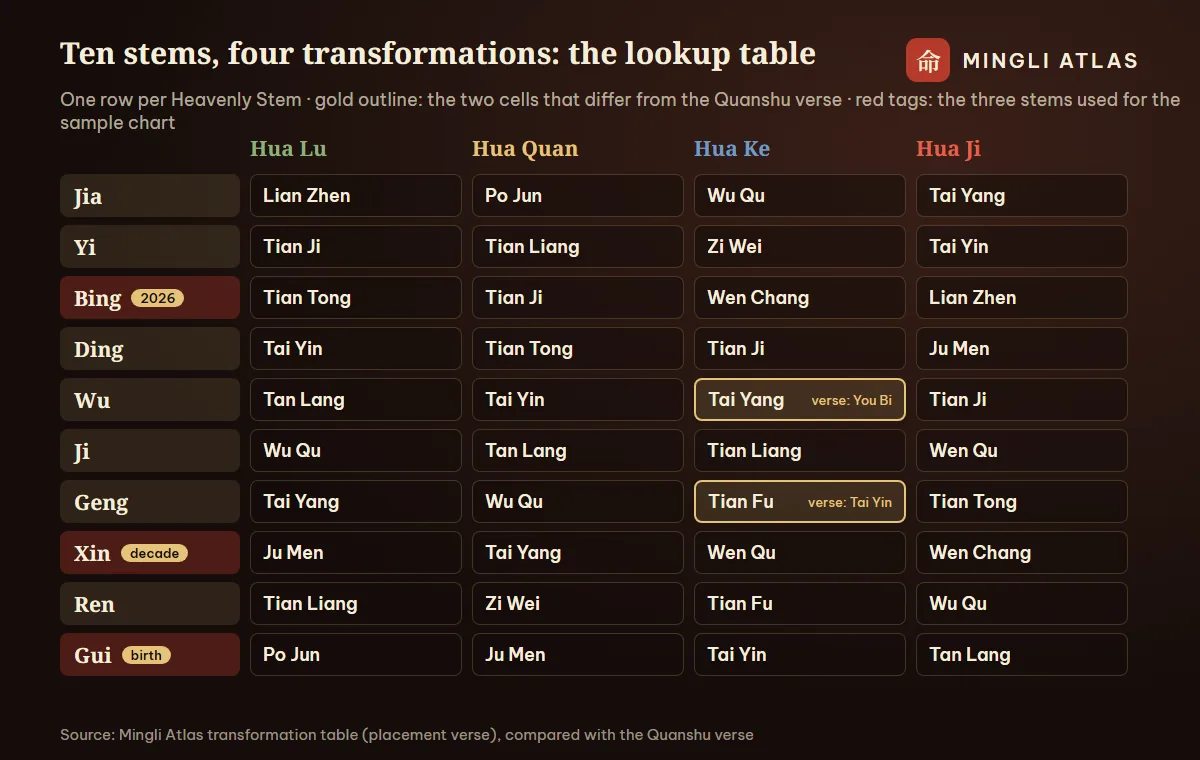
A few quick-lookup patterns show in the table. Every row holds four different stars, so a stem never gives one star two transformations. One star can transform differently under different stems (Tian Ji becomes Hua Lu under Yi, Hua Quan under Bing, Hua Ke under Ding and Hua Ji under Wu). And the ten stems give ten different Hua Ji stars, with no two stems sharing one.
Which two cells differ from the Quanshu verse?
The Mingli Atlas table differs from the Four Transformations verse in the Quanshu in exactly two cells, both Hua Ke. The gap is recorded by comparing the table with the source in code, not estimated.
| Stem | Transformation | Mingli Atlas table | Quanshu verse |
|---|---|---|---|
| Wu | Hua Ke | Tai Yang | You Bi |
| Geng | Hua Ke | Tian Fu | Tai Yin |
For the other eight stems the two agree star by star. Some tables elsewhere follow the verse and some follow the placement verse, and one chart can show two different Hua Ke stars for that reason alone. This site follows the placement verse and says where it differs instead of hiding it; how schools discuss those two cells is in the four transformations guide.
The three layers on the sample chart
The sample chart has its Life palace at Hai and the Water Two Bureau. The natal layer uses the stem Gui (birth year 2003), the decade layer uses the stem Xin of the Spouse palace at You (ages 22 to 31), and the annual layer for 2026 uses the stem Bing. The table below looks each star up on the chart to find its palace.
| Layer | Stem | Hua Lu | Hua Quan | Hua Ke | Hua Ji |
|---|---|---|---|---|---|
| Natal (birth year 2003) | Gui | Po Jun (Property) | Ju Men (Wealth) | Tai Yin (Travel) | Tan Lang (Health) |
| Decade limit Spouse, ages 22 to 31 | Xin | Ju Men (Wealth) | Tai Yang (Spouse) | Wen Qu (Children) | Wen Chang (Health) |
| Annual 2026 | Bing | Tian Tong (Wealth) | Tian Ji (Life) | Wen Chang (Health) | Lian Zhen (Friends) |
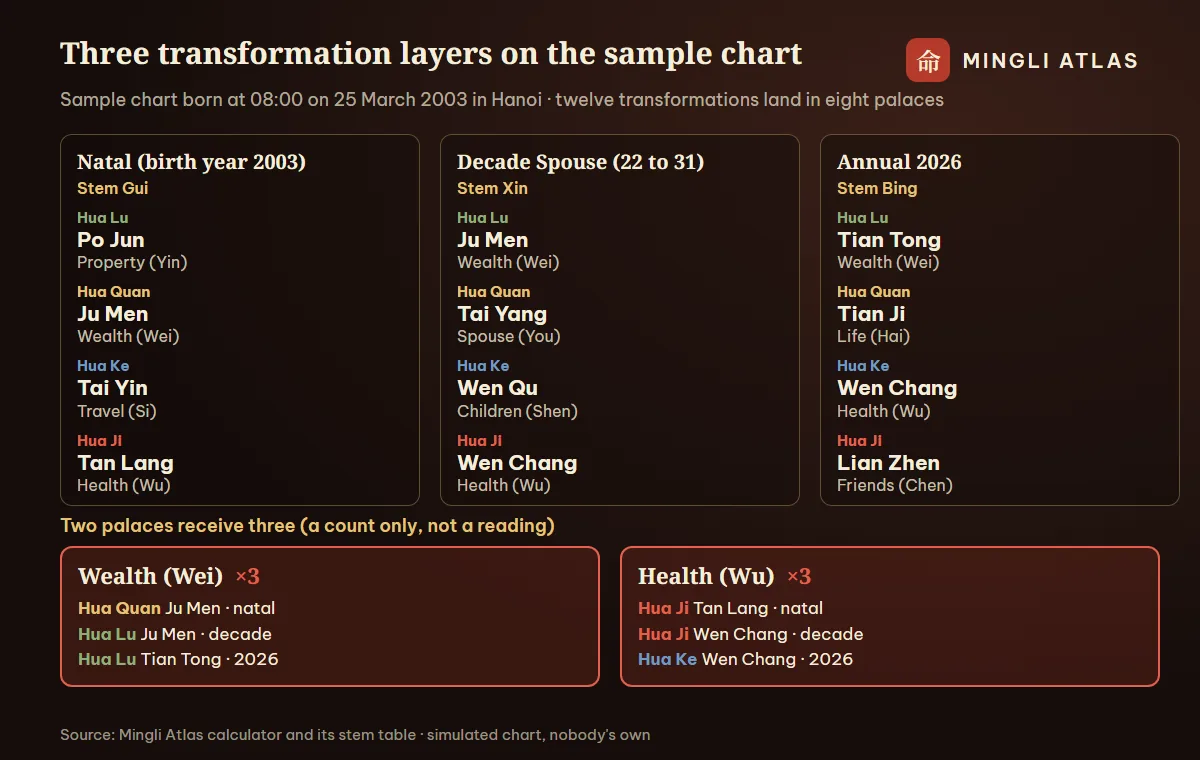
With three sets of four stars, the first job is to count how many transformations each palace receives. On the sample chart the twelve transformations land in eight palaces: Wealth and Health take three each, while Property, Travel, Life, Spouse, Children and Friends take one each. Wealth receives the natal Hua Quan (Ju Men), the decade’s Hua Lu (also Ju Men) and the 2026 Hua Lu (Tian Tong). Health receives the natal Hua Ji (Tan Lang), the decade’s Hua Ji (Wen Chang) and the 2026 Hua Ke (also Wen Chang). Counting only shows which palace several layers touch, not whether those layers are good or bad; that belongs to the reading step, in how to read a Zi Wei chart and the guide to Hua Ji. Transformations act on a palace through its trine and opposite palaces, see the three directions and four correspondences.
How to place the Four Transformations step by step
- Choose the layer to place: natal, decade or annual.
- Take that layer’s stem: the lunar birth-year stem, the stem of the running decade palace, or the stem of the year read by Lunar New Year.
- Look up that stem’s row in the ten-stem table to get the four stars.
- Find each star on the natal chart to see which palace it sits in (see how to place the 14 main stars for the main stars).
- Write down which transformation goes in which palace, then repeat for the other layers.
- Count the transformations each palace receives, and only then move to reading.
Common mistakes
- Taking the current year’s stem for the natal transformations, or the birth-year stem for the annual ones.
- Taking the birth year by Start of Spring instead of Lunar New Year, so people born between the two dates get the wrong stem.
- Using the Life palace’s stem as the decade stem instead of the stem of the decade palace now running.
- Mixing the verse table and the placement-verse table in one chart, so the Hua Ke cells of Wu and Geng come out inconsistent.
- Treating Hua Ji as certainly bad, or Hua Lu as certainly good, from the name alone.
A chart is a frame for self-reflection, not a fixed prediction, and transformations are material for reflection only. How Mingli Atlas places and reads charts is on the methodology page; to see the three layers on your own chart, build a Zi Wei chart.
Keep reading
From reading to your chart
See your own chart
Free BaZi and Zi Wei charts, read against the classical texts, with no email needed.